
Bluffton City Directory Holdings
There is no verified, authoritative online inventory for a complete run of printed Bluffton directories, reverse directories, or criss-cross volumes. That is a meaningful limit, not an invitation to supply guessed publishers or dates. The practical starting point is the Beaufort District Collection, the local-history repository of Beaufort County Library. Ask staff whether a Bluffton, greater-Beaufort, telephone, reverse, neighborhood, or address-oriented volume exists for the exact decade. Record the title, publisher, year, volume, page, section heading, and abbreviation key before treating it as evidence.
| Collection | Years | Where Held | Access |
|---|---|---|---|
| Beaufort District Collection local history | 1752 to present, broad scope | 311 Scott Street, Beaufort | Appointments recommended; maps, microfilm, genealogy, files, and books. |
| Local newspaper microfilm | Beaufort County newspapers from 1862 | Beaufort District Collection | In-person historical research; pair names with obituary entries. |
| Online Obituary Index | 1862 to approximately 1992 | Beaufort County Library | Online index; request the published obituary by phone or email. |
| Federal census microfilm | 1790 to 1880 and 1900 to 1930 | Beaufort District Collection | Historical household and place research. |
| Published city or reverse directories | No inclusive Bluffton run verified | Ask BDC or the library catalog | Confirm a volume exists before citing it. |
The documented shelf is wider than one printed format. BDC also offers digital materials, finding aids, local-history assistance, and on-site Ancestry Library Edition access. The library describes that database as available on library computers or library Wi-Fi, not from home. A library listing can establish that an item is held. The individual volume, its date, and its printed conventions still need inspection.
For a request that cannot be answered online, use the fallback chain in order: the BDC catalog and local-history staff, an in-person review of microfilm or files, Caldwell Archives for Bluffton-specific interpretive material, then the South Carolina Archives for the identified county series. A certified land, probate, or court record remains with its county custodian. Libraries and archives can help identify a source, but they do not certify a current legal record.
Bluffton City Directory at BDC
BDC serves the historic Beaufort District and the surrounding Lowcountry, including Beaufort, Hampton, and Jasper counties. Its documented holdings include books, maps, photographs, vertical files, letters and diaries, selected local records, and microfilm. It is open Monday through Friday from 9 a.m. to 5 p.m.; appointments are recommended for substantial research. For material or copy questions, use 843-255-6468 or bdc@bcgov.net. The library’s local-history pages also point to digital collections and finding aids, while archival material is available by appointment.
Start a Bluffton volume request with the target name, approximate year, and any old street, neighborhood, parcel, or obituary clue. Ask whether the collection has a matching directory, telephone book, yearbook, or reverse-volume substitute. This keeps a historical search tied to a dated source instead of turning a broad repository description into an unverified directory claim.
The BDC location page identifies the collection as a local-history, maps, microfilm, and genealogy repository.
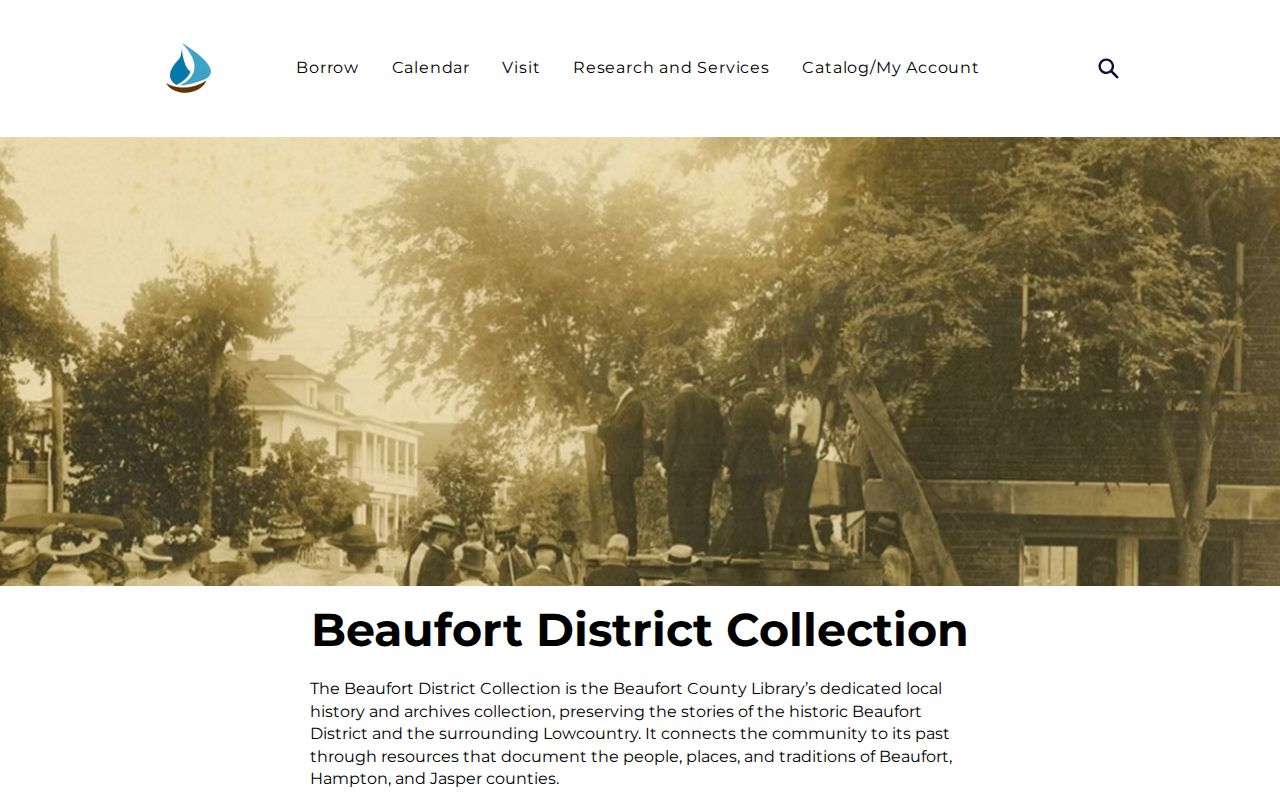
The collection is a research stop for historical Bluffton records, not proof that a complete city-directory run is held or digitized.
Reading Bluffton City Directory Clues
No verified digitized Bluffton entry was available in the research materials. For that reason, no local abbreviation, spouse notation, occupation layout, owner mark, or page pattern should be assumed. Once BDC identifies a relevant item, inspect the title page and key first. Then capture only the fields the actual volume prints and preserve the page citation beside the transcription.
| Printed name | Copy spelling, initials, and any name variant exactly as the volume presents them. |
|---|---|
| Address or locality | Record it only if printed, then compare it with a dated map, parcel, or census source. |
| Occupation or organization | Use only when that particular volume includes it; no Bluffton layout has been verified here. |
| Householder or ownership mark | Do not infer one. Photograph or transcribe the volume’s own key before interpreting a mark. |
| Source citation | Keep title, publisher, year, volume, page, and the library or archive location together. |
- Criss-cross directory
- A directory arranged by street or address rather than by a person’s name. No complete Bluffton run was verified, so ask BDC about a specific decade.
- Householder index
- An index that may identify the named household reference in a volume. Its presence and meaning depend on the book being inspected.
- Abbreviation key
- The page that defines a volume’s short forms and symbols. It should be read before any entry is interpreted.
A listing can support a modest conclusion: the source placed a printed name or detail in that volume at publication time. It cannot settle a title question, prove that every person at an address was included, or establish a present connection. Compare it with a census, obituary, deed, plat, or other source whose date and purpose are known.
Caldwell Archives for Bluffton
The Historic Bluffton Foundation’s Caldwell Archives is the direct local archive for Old Town property history, historic structures, photographs, plans, and family or local narratives. It is at Town Hall, 20 Bridge Street, Bluffton. A session requires advance scheduling and a written summary of the requested items and purpose. The Foundation lists a $30 hourly base research fee payable when booked; Tuesday availability and extra dates by request were listed when the collection was inspected.
Use Caldwell after a parcel, deed, map, or dated household clue has identified the property or period. It can supply local context that a county portal cannot, but it does not replace the recorded document held by Beaufort County or establish a complete person roster. Contact the archive at caldwell.archives@historicbluffton.org or 843-757-6293 before making a trip.
The Caldwell Archives appointment page explains the request and fee process.
For a historic property, the archive works best beside the parcel identifiers, deeds, census material, and citations already collected.
Bluffton City Directory Street Index
BDC’s Bluffton history guide identifies an unpublished Bluffton Street Index by the Beaufort County GIS Department, dated 2006 and classified SC 912.75799 BEA V.1. The index maps streets and parceled land. Its stated limit is equally important: it does not identify land owners. A historic street clue can therefore become a parcel or map lead, but it cannot by itself establish an owner, occupant, or household.
Use the street index to reconcile an older street reference with physical geography, then match the parcel’s legal description or PIN in the county property system and Register of Deeds. Modern address-keyed work belongs with the Bluffton street directory process, where parcel and title records are treated as separate evidence.
Note: A street-to-parcel reference is useful only when its date and map context are kept with the later county-record match.
The Bluffton Records-Loss Story
Historical research in Bluffton has a real survival problem. The South Carolina Department of Archives and History reports losses to Beaufort County records after the February 1865 destruction of Beaufort. An empty index can therefore reflect a loss, a non-digitized series, or a different filing path. It is not sound proof that an event, transfer, or household never existed. The Town also describes major destruction in 1863, adding another reason to separate surviving evidence from a polished local story.
- 1862: BDC newspaper microfilm begins, creating a dated local source that can survive outside a land record.
- 1863 and 1865: Town and county record-loss history creates gaps that must be named, not filled with guesses.
- 2006: The unpublished Bluffton Street Index offers street and parcel geography without owner names.
- February 2026: Beaufort County split Register of Deeds searching between current and legacy systems.
The South Carolina Archives Beaufort County guide identifies conveyance, plat, court, and tax-related series. Ask for a series description and date range before assuming a modern screen includes nineteenth-century records.
Tracing Bluffton City Directories
A historical household trail should begin with a documented date and place, such as a parcel situs or legal description, a newspaper notice, or a census household. When a BDC volume is located, use it as one dated observation. The library holds Beaufort District and County federal census microfilm for 1790 through 1880 and 1900 through 1930; the missing 1890 population schedule remains a national gap. The public 1950 census is another later released schedule, not a substitute for current information. Individual census schedules follow a 72-year public-release practice.
- Start with a date, place, and source citation already in hand.
- Search BDC’s obituary index and local newspaper microfilm for notices, estate references, social items, and address clues.
- Ask BDC whether a directory, telephone book, reverse volume, or yearbook exists for that decade, then cite the actual item.
- Pair the date with the appropriate released census schedule and compare names, place, and household details.
- When the trail becomes a title or estate issue, obtain the matching Register of Deeds, Probate, or court record from its custodian.
The BDC Online Obituary Index contains more than 24,000 locally reported deaths from 1862 to approximately 1992. An index hit is a lead; request the published notice and compare it with the dated household record.
Bluffton Business-License Context
A town business-license result can add context when a historic address is tied to an organization, but it is not a people directory. Bluffton’s search menu supports business-name searches and lists for licenses issued, newly opened, or closed within a chosen date range, with an Excel export. Its reach is municipal: a business associated with greater Bluffton may fall outside Town limits, and a result does not establish a person’s residence or continuing connection to a place.
The Town of Bluffton Business License Search describes the available search paths and export option.
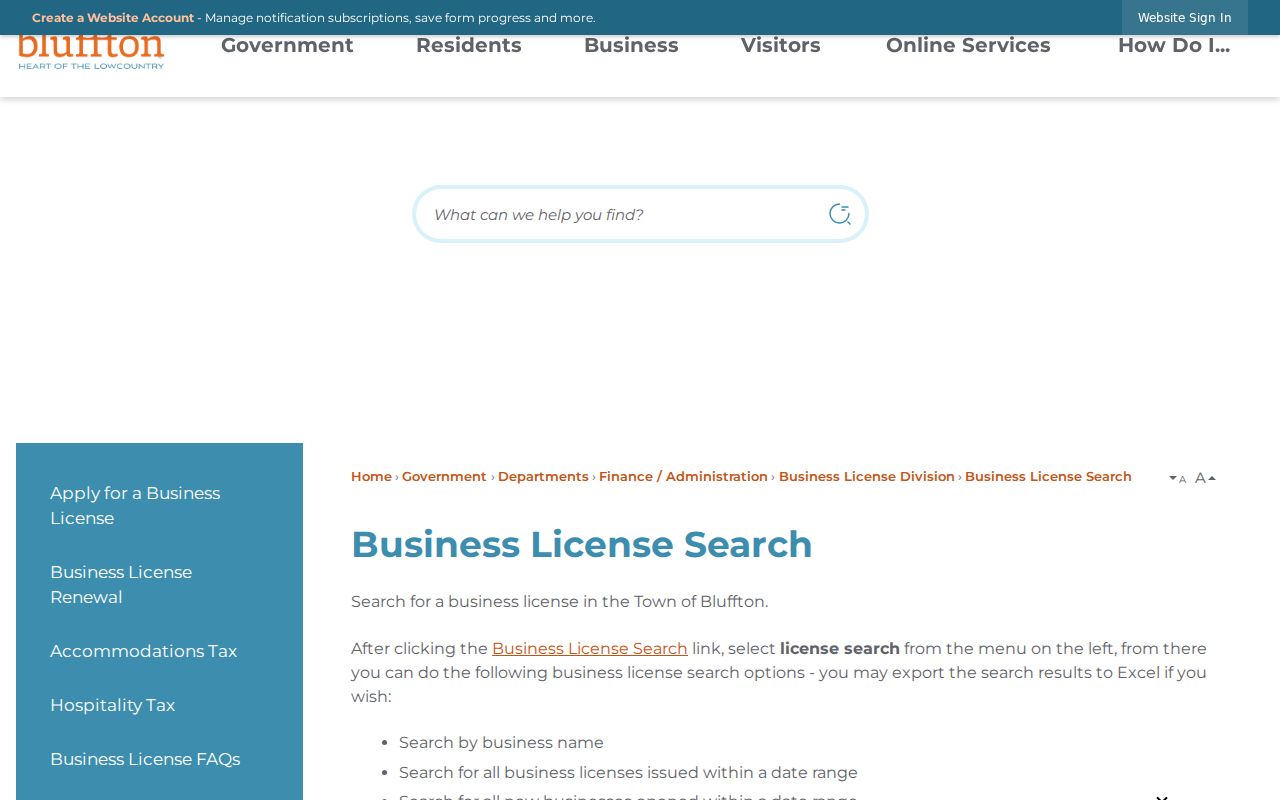
Keep the Town result with its date and jurisdiction, then use the relevant county or archive source for a property, historical-household, or recorded-document question.