
Bluffton Previous Residents by Era
No one database proves every past household at a Bluffton address. A reliable search moves from current parcel identity to recorded transfers, then to dated household material and archival sources. The legal description and county PIN are the durable links because street formatting, subdivision phases, Town limits, and mail ZIPs can change. Treat each row below as a source type with its own coverage and limits, rather than as a single roster of everyone who lived at the address.
| Source | Years It Covers | Where Held | What It Shows |
|---|---|---|---|
| ROD current search | Converted/current data from February 23, 2026 | Beaufort County Neumo search | Current-system recorded-document searching. |
| ROD legacy search | Legacy route through February 19, 2026 | Register of Deeds legacy link | Earlier system route, not an asserted deed-origin date. |
| SCDAH conveyance books | 1863 to 1926 | South Carolina Archives | Historical recorded conveyances. |
| BDC census microfilm | 1790 to 1880 and 1900 to 1930 | Beaufort District Collection | Dated household and place evidence. |
| BDC newspapers and obituary index | Newspapers from 1862; index 1862 to about 1992 | Beaufort County Library | Notices, deaths, and local context. |
| Caldwell Archives | Collection-dependent scope | Historic Bluffton Foundation | Historic-property and local narrative research by appointment. |
For a recent title question, begin with the parcel and the Register of Deeds. For an older household question, add BDC census and newspaper sources. If the address is in Town jurisdiction, the public permit finder can supply a project-date lead, but its coverage date is not published and it is not a household record.
Bluffton Previous Residents Two-Portals
Beaufort County’s February 2026 Register of Deeds conversion creates a local trap for previous-residents research. The current Neumo environment contains data converted beginning February 23, 2026. The county directs researchers to its legacy New Vision route for material through February 19, 2026. A no-result in one system is not enough to conclude that a prior transfer or party record does not exist.
Search both environments when the deed history crosses the split, then use the Register’s older-record instructions for handwritten grantor, grantee, mortgagor, mortgagee, and plat indexes. Those instructions use the INDEX document type for certain historic books and an OLD PLAT name search for older plats. The county has not published one universal online starting year for all deeds, so do not convert a portal-migration date into a claim about the beginning of the record series.
Bluffton Previous Residents Parcel Keys
The Beaufort County Public Access property search accepts a street address, owner name, PIN, AIN, or legal description. It is a practical opening step because it can show a parcel’s situs, PIN or AIN, legal description, owner field, valuation, and sale or ownership-history leads. The county updates this service each business day and expressly says it is not the official tax record. Use it to identify the parcel, then confirm a transfer in the recorded instrument.
The distinction between situs and mailing information matters. Situs is the physical parcel location. An owner mailing address is where correspondence is sent and may be elsewhere. A legal description identifies the land through its lot, block, subdivision, map, or other formal wording. For past residents, the description and PIN are stronger bridges than a street string when a development phase, map, or address format has changed.
- PIN or AIN
- A county property identifier. Save the exact value because it links the property search to later record checks.
- Situs address
- The physical location recorded for the parcel. It is distinct from an owner’s correspondence address.
- Legal description
- The formal language that identifies the land, often more stable than a historic street-address format.
Beaufort Deed Chain Backward
A chain of title is the documented sequence of transfers for one parcel. It is built from instruments, not from an assumption that every named party lived there. Start by matching the parcel’s legal description and PIN to the recorded document. That match helps avoid a same-name error and shows whether a change involved a sale, trust, estate, subdivision, financing document, or another event that needs separate treatment.
- Search Public Access by situs or PIN and record the exact PIN, legal description, current owner format, and any sale-date clue.
- In the Register of Deeds advanced search, look for the present owner as a grantee, adding a legal description, parcel number, date range, book and page, or document type when needed.
- Read or request the matched instrument. Log its recording date, document number, book or page, document type, grantor, grantee, and matching land description.
- Search the prior seller as a grantee to locate that party’s earlier acquisition, then repeat only when the parcel relationship matches.
- Pause at trusts, estates, quitclaims, refinances, corporate transfers, partitions, or replats. Those events may not show a simple change in who lived at the address.
- Check current and legacy portals, then move to ROD instructions, the counter, email copies, or State Archives series when the online trail stops.
- Grantor
- The party transferring an interest in the recorded instrument.
- Grantee
- The party receiving that interest. A former seller may be found earlier as a grantee.
- Chain of title
- The source-backed sequence of land transfers for the same property, checked against the legal description or PIN.
Reading Beaufort ROD Results
The advanced Register of Deeds form supports party names, grantor, grantee, recorded-date range, document types, document numbers, type, book, page, legal description, parcel number, and a document-image phrase. Party names are entered last name first. A party field gives a document lead, not an occupancy finding. The useful result is the one whose date, instrument type, and property description agree with the known parcel.
The Beaufort County Register of Deeds advanced search displays the party, document, legal-description, and parcel routes used to locate a recorded instrument.
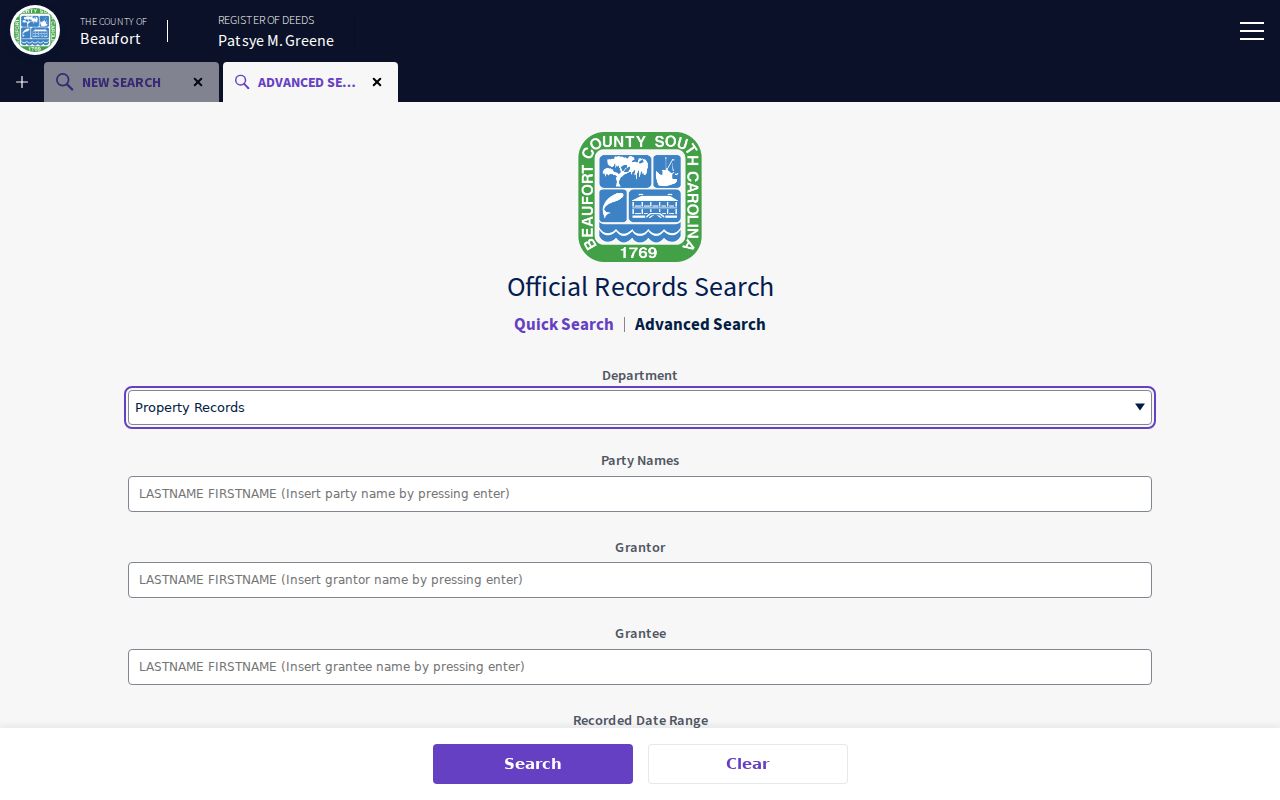
Keep the document number and matching legal description in the research log so that a later reader can check the same record rather than rely on a name alone. If an image or older book cannot be reached online, the Register lists an email document-request route and processes requests in received order.
Bluffton Previous Residents Past Households
Deeds identify the parties to property transfers. Past residents require a second, dated layer. BDC holds federal census microfilm for Beaufort District and County from 1790 through 1880 and from 1900 through 1930, while its local newspaper microfilm starts in 1862. Its Online Obituary Index has more than 24,000 names from locally reported deaths between 1862 and approximately 1992. These records can anchor a household in time, but they should be compared with the address, parcel, and date rather than treated as current information.
- Choose a deed, obituary, census, or parcel event with a definite date.
- Ask BDC whether a directory, telephone, reverse, yearbook, or local collection exists for that decade. No complete Bluffton directory run was verified.
- Pair the date with the appropriate released federal census material and compare the place and household evidence.
- Use newspaper or obituary material to test a move, death, estate, or family reference.
- Move to Probate or the Register of Deeds when the evidence points to an estate or recorded transfer.
The documented collection routes, their access limits, and the caution against inventing directory years are detailed on the Bluffton city directory page. A directory entry, when a relevant volume is found, is evidence of a listing at publication time, not proof of ownership or every household member.
The Beaufort District Collection supplies the local-history, maps, microfilm, and genealogy route behind this household layer.
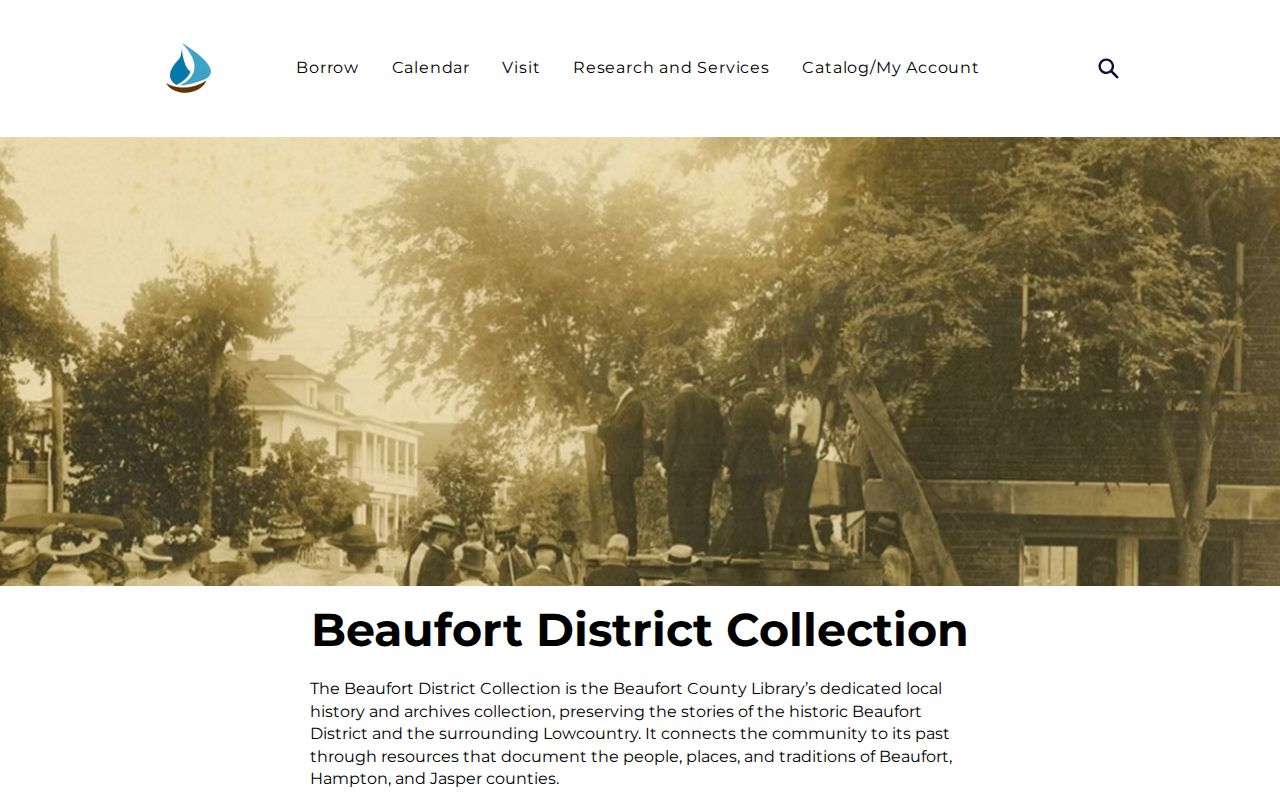
Use a BDC result alongside the dated county instrument or census source, especially when a surname is common or the address has changed form.
Bluffton’s 1865 Records Loss
The South Carolina Archives reports losses to Beaufort County records after the February 1865 destruction of Beaufort. Town history also describes extensive Bluffton destruction in 1863. Those facts explain why a careful historic search may need surviving plats, later conveyances, newspapers, census material, vertical files, and family collections. They do not prove that a particular building, record, or address was destroyed.
There are modern continuity traps as well. Bluffton expanded from a one-square-mile historic municipality to roughly 54 square miles through annexation, and its boundary is patchwork. A Bluffton postal address or ZIP does not establish Town jurisdiction. Preserve the legal description and PIN, compare dated maps and plats, and check whether a Town record would apply before treating a permit or municipal file as part of the address history.
Note: An index miss can reflect record loss, non-digitized material, changed geography, or a different custodian, so preserve the unsuccessful search terms and dates.
Bluffton Previous Residents Limits
Use prior-address research for family history, property history, estate work, local history, and personal curiosity. Keep findings narrow and source-based. County records distinguish a mailing address from a situs address, and recorded parties are not automatically residents. Do not publish sensitive personal details or use historical material to target, pressure, monitor, or repeatedly contact someone.
For a source that is not available online, use the right custodian rather than a broad request. The Register of Deeds accepts document requests at 100 Ribaut Road in Beaufort and lists copies at $0.50 per page with $10 certification. BDC can answer material and copy questions at 843-255-6468. Caldwell Archives requires a scheduled session and written research summary. These routes preserve the difference between a historical lead, a document copy, and an archival interpretation.